
Advanced Amazon PPC Strategy:
At first, Amazon PPC was just about keyword bidding, but now it has become a sophisticated, data-driven advertising system. Experienced sellers can no longer suffice with running just basic auto and manual campaigns. In fact, to remain competitive, sellers will need to implement advanced Amazon PPC strategies geared toward precision targeting, conversion optimization, and scalable profitability. 
This advanced guide from EcomLeaner shows you how to polish up your Amazon PPC strategy by using data analysis, funnel-based campaign structures, and performance scaling techniques.
Advanced PPC success starts with understanding the customer buying funnel on Amazon:
Awareness Sponsored Brands & Broad keywords, Consideration Phrase match & ASIN targetingConversion Exact match & retargeting ads. Basically, a properly planned PPC funnel guarantees that the different stages of buyer intent are taken into account while spending the ad money wisely.
Advanced Campaign Structuring Strategy:
1. SKAG (Single Keyword Ad Group) Method:
SKAG gives the most control over bids and performance.
Benefits:
- Precise bid
- management Higher relevance
- score Better conversion rate
Best use:
- High, volume, proven keywords.
- Top 10 converting search terms.
Each ad group contains one exact match keyword thus making optimization easier and more profitable.
2. AlphaBeta Campaign Structure:
This structure allows separating keyword discovery from profitability.
Alpha Campaigns:
- Exact match High,
- converting keywords
- Higher bids and budget for Beta Campaigns
Broad and Phrase match keywords testing, Lower bids. Every week, one woking keywords can be moved from Beta to Alpha campaigns.
Advanced Keyword Harvesting Techniques:
Harvesting keywords is a point to go beyond the auto campaigns.
Harvesting sources:
Search Term Reports
Competitor ASIN targeting campaigns
Brand keyword campaigns
Sponsored Display search insights. Filtering criteria:
ASIN & Competitor Targeting Strategy: 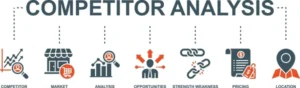
Product Targeting Ads:
Directly target ASINs of competitor brands to divert traffic from their listings to yours.
Best practices:
Target similar, priced products.
Target competitor listings with lower ratings.
If your product is cheaper, exclude premium, priced ASINs
Combine Sponsored Products + Sponsored Display for full market dominance.
Placement, Based Bid Optimization:
Amazon permits submitting bid adjustments based on placements:
- Top of Search
- Product Pages
- Rest of Search
Advanced strat:
For highly converting keywords, increase Top of Search bids by 30, 100%
For low CTR placements, reduce Product Page bidsCheck placement report every week.
This method very much increases both the product’s visibility and the ROI.
Dayparting & Budget Control:
Dayparting is one of the ways advanced sellers use to decide which hours will their ads be running.
Benefits: 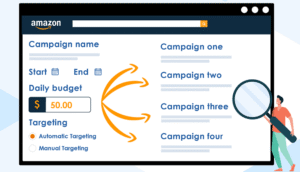
Reducing wasted spend during low, conversion hours.
Allocating budget during peak buying times.
With the help of PPC automation tools, you can:
Shutdown ads at night.
Bidding up during peak hours.
Have a tighter control over daily budget depletion.
Advanced ACoS & TACoS Strategy:
Understanding TACoS
TACoS (Total Advertising Cost of Sales) reflects the overall level of the brands health.
Formula:
TACoS = ad spend / total revenue
Advanced benchmarks:
TACo Search Term Isolation & Negative Keyword Mastery
Negative keywords play a vital role in advanced optimization. 
Types:
Negative Exact prevents certain queries only
Negative Phrase blocks variations
Advanced rule:
Add negative keywords every 35 days
Remove non-converting clicks after 1015 clicks
Separate branded from non, branded traffic
This way, you can reduce your wasted spend and increase your profitability.
Sponsored Brands & Video Strategy:
Sponsored Brand Video Ads: 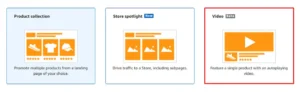
- These ads give:
- Higher CTR
- Lower CPC
- Mobile dominance
Best practices:
-
Focus on a single hero product
-
Use benefit-driven messaging
- Keep videos under 30 seconds.
Retargeting & Audience Strategy:
Sponsored Display is a great way to retarget an audience by showing them your ads again.
Advanced use cases:
Retarget product viewers
Cross, sell complementary products
Target competitor audiences
Sponsored Display with coupon offers is a great combination which leads to higher conversion rates.
Automation vs Manual Control:
The most advanced sellers take advantage of automationbut they set restrictions.
Automate:
- Bid adjustments
- Dayparting
- Scaling Without Killing Profit
Scaling rules:
Increase budget step by step (2030%)
Only scale campaigns that have proven profitability.
Watch TACoS and not only ACoSCarefully expand into new keyword clusters.
If you scale aggressively without data, you will lose money.
Advanced Amazon PPC Errors to Stay Away from:
Over, automation without supervision
Neglecting brand defense campaigns
Volume chasing and ignoring profitability
Not differentiating between brand and non, brand ads
Failing to leverage Sponsored Display
Keeping away from these mistakes makes your PPC performance experienced, and stable.
Concluding Remarks:
Advanced Amazon PPC is about control, data, and targeted advertising based on consumer intent. Those sellers who are experts in campaign structuring, placement optimization, and long-term TACoS management will not only dominate the search results, but they will also retain profitability.
Case Study Overview:
Product Category: Home & Kitchen (Private Label)
Marketplace: Amazon USA
Price: $29.99
Fulfillment: FBA
Seller Size: Small, Medium
Initial PPC Issues
High ACoS (68%)
No campaigns structure
Spending on irrelevant keywords was wasted
Amazon PPC Case Study: Reducing ACoS by 68% to 24% in 60 Days
Private label Home & Kitchen seller turned an unprofitable advertising account into a scalable, profitable system in 60 days, according to this Amazon PPC case study conducted by EcomLeaaner.
The first thing that the seller was struggling with was a 68% ACoS, badly planned campaigns, a huge amount of money spent on irrelevant keywords and a low 8.4% conversion rate. The monthly ad spend was $3, 200, resulting in only $4, 700 of PPC sales.
The optimization process began with the creation of a better listing such as new images, keyword, optimized titles, improved bullet points, A+ Content, and competitive pricing. Just by doing that the conversion rate hit 12.9%.
Then, campaigns were completely restructured and the Alpha, Beta model was used to separate keyword discovery from profitability. Regular search term harvesting and aggressive negative keyword implementation helped to cut down wasted spend by 27%.
Further improvement in performance was achieved by placement, based bid optimization, Sponsored Brand Video ads, and Sponsored Display retargeting.
At the end of the 60-day period, monthly PPC sales hitting $15, 600, ACoS falling to 24%, TACoS improving to 17%, and conversion rate going up to 15.8%. All these data prove that the implementation of a well, researched Amazon PPC strategy leads to profitable operations for a long time.