
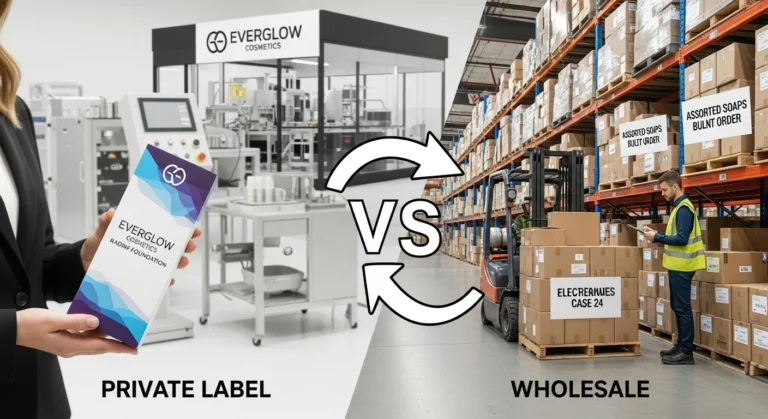
Private Label vs Wholesale:
Which Is Better for Your eCommerce Business?
eCommerce entrepreneurs are always struggling to figure out which business model would bring them the most profit, as well as increase their brand recognition. The two most popular approaches are Private Label and Wholesale. These models both have advantages and disadvantages, by which you largely depend your goals, money, and business strategy. This complete comparison will explain to you the pros and cons of private label vs wholesale so that you can decide which one will be the best for your eCommerce trip.
What Is Private Label?
Private Label refers to the practice of offering products that are produced by a third, party company but carry and promote your own business brand name.
Pros of Private Label:
Brand Ownership and Recognition:
One of the most significant benefits of private labeling is probably the fact that the brand is still yours. Customers identify your company as the producer of the product, which is very helpful in creating and keeping brand loyalty over time.
Higher Profit Margins: 
As the one in charge of pricing, branding, and marketing, you have the opportunity to set your product as a premium one and thus, obtain higher margins in comparison to the simple reselling of wholesale goods.
Creative Control:
You have the power to determine the product’s design, packaging, ingredients, and even the marketing strategy. Such a degree of freedom enables you to set your business apart from the competitors.
Scalability:
When your private label products become popular, it is practically a matter of scaling. You can add new versions, broaden your product range, or even venture into new markets.
Customer Loyalty:
In many cases, private label brands develop even stronger relationships with customers as buyers link the product’s value directly to your brand.
Cons of Private Label:
Higher Initial Investment: 
A private label setup through product design, packaging, and branding will require an initial investment. Additionally, the manufacturer may ask you to meet the minimum order quantity (MOQ), which can be expensive if you are just starting out.
Longer Setup Time:
Your private label product development can take weeks or even months due to production, sampling, and testing.
Risk of Unsold Inventory:
Because you are customizing products and buying in bulk, the risk of leftover inventory is higher if the product does not sell as expected. Manufacturer Dependency The quality control and production timelines of the manufacturer are what your business depends on most. Any issues they have will affect your brand’s reputation directly.
Need for Strong Marketing:
If you compare wholesale with private label, you will see that products under wholesale already have brand recognition. So, private label products require more marketing and getting the trust of new customers.
What Is Wholesale?
Wholesale is a business model that involves buying branded products in bulk from the producer or a middleman at a lower rate, and then selling them at regular prices for the end consumers. It is not a business model for creating a new brand. Rather, it is a model where you leverage the existing products that are already known by the customers. A retailer, for example, may decide to purchase Nike shoes and Apple accessories in bulk and then sell them on an eCommerce platform at a higher price.
Advantages of Wholesale:
- Easy to Start As the products are already developed and branded, the seller can start the business soon after purchasing the inventory.
Low Marketing Effort: 
- The seller is dealing with established brands that customers already know and trust. Therefore, less work is required to convince them of product quality.
Lower Risk of Product Failure:
- Since the seller is dealing with proven products that already have demand, there is less risk when compared to the situation of creating a new brand.
Flexible Product Range:
- The seller is free to select multiple brands and categories, thus, not being required to commit to a single manufacturer or product line.
Predictable Profit Margins:
- Most of the time, wholesale provides a steady, predictable income as the reseller is dealing with known brands that have a consistent demand in the market.
Cons of Wholesale:
Lower Profit Margins:
As a result of the same branded products being sold by multiple retailers, price competition can lead to the reduction of margins.
Limited Brand Control:
Being a product of another company, you have very little or no control over the quality, packaging, or marketing strategy.
High Competition:

Non, exclusive wholesale products can be easily sourced and sold by others, which results in marketplaces getting crowded and price wars occurring.
Inventory Management:
When you buy in bulk, you will need enough storage space and good inventory management systems if you want to avoid overstock or deadstock.
Dependence on Brand Popularity:
In case the brand you sell gets less popular or is no longer valuable in the market, your sales will be going down quickly.
Which Model Is Better for You?
You can almost immediately start selling and gain knowledge about market trends, inventory management, and eCommerce. If your goal is to create a brand that lasts and you have the financial means to invest in product development and marketing, then private labeling is a better option. You will have more freedom, a stronger brand, and higher profit margins. There are some entrepreneurs who choose to work with both models they start with wholesale to get a grip on the market and then slowly move to private label products once they figure out what sells best.